
Ayshe-Mira Yashin chats to Kaan about her eco-feminist art style, deconstructing power in tarot readings and their intimate DIY process of printing each of her decks by hand.
Your illustration style is really beautiful. What inspires/informs your art?
My illustrations that are narrative-based or sequential, including my tarot deck, are influenced a lot by artists who use visual storytelling to invite the viewer into their personal and political lives, and reimagine myths or folktales through a matriarchal lens. Some of my favourite artists along that vein are Citra Sasmita, Samira Abbassy, Hayv Kahraman and Frida Kahlo. My all-time favourite artist is Ana Mendieta, the pioneer of the earth-body art genre, where she explored entanglements between the “feminine” body and the earth using her own silhouette. Part of my practice is to do with creating contributions to this genre using organic matter gathered from specific sites in combination with materialities of the body.
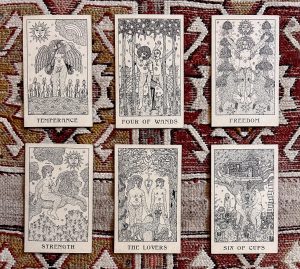
An ongoing source of inspiration is a community of artists who I met in 2024 during an artist residency for an exhibition called Burned House Horizon at Mimosa House, London (January – February 2025). The residency involved queer communal rituals and art-making around collective reimaginings of neolithic spiritual practices. The artists I met there continue to inspire my spirituality as well as my approach when making new work.
Recently, I participated in a residency at Endrosia Project Space in Nicosia in collaboration with filmmaker and artist Lujain Tamer Mansour. Endrosia is a Cypriot artist collective focused on long-term research projects around the use of Cyprus as a node for regional surveillance; their works have been a primary reference in the spatial research-based aspect of my practice. My work is especially informed by my involvement in the community of House of Annetta, a non-institutional space in East London used by artists and researchers working around spatial justice-related issues.
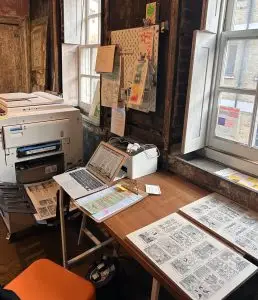
We absolutely adore your manual printing methods, your hand bound zines, and the very DIY relationship you have with each and every deck and zine you make. Was there a conscious decision behind choosing to assemble the decks and zines yourself like this? (If so, can you tell us a bit about it)
I don’t ever want to hand my tarot deck or zines to mass production. For me, the process of stitching each zine by hand, risograph printing the decks, cutting out the cards one-by-one with a guillotine and assembling the boxes are all ways of keeping Earth Mother Magic Tarot alive as an artistic project. I choose to maintain autonomy over the entire production process of the tarot decks, so I can ensure no component of the decks is unethically sourced or misaligned with the ecofeminist values of the deck. Since I know the recipients of the tarot decks tend to be other women or queer people, I weave my energy and intentions into each deck whilst creating them by hand. I also include herbal sachets which I make myself with ingredients from my altar in each parcel. The manually printed and handmade nature of the decks does mean it takes me longer to produce them than the mass-produced decks one might find on Amazon or in many witchy shops (mainstream and not)… but I feel the slower pace is worth it.
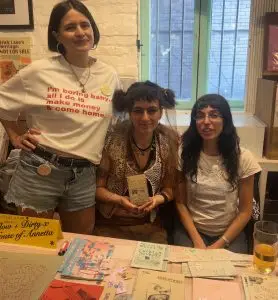
Last year, I started printing the tarot decks at Slow + Dirty Press, the feminist community press based at House of Annetta. It has been incredibly fulfilling to have printed the last editions of decks at a press rooted in values of collective resource sharing, mutual support and alliance across political causes, knowledge circulation and feminist companionship. Every time I go to House of Annetta to restock the cards, I feel so happy to be doing so in a space where I am alongside other women, queer people, organisers and artists/designers making work around spatial justice-related issues – all of whom are part of the communities the deck was intended for.
Over emails, you shared that you’ve been developing your tarot practice these past few months. Could you share more about this, particularly your exploration of collective/community-based approaches to tarot readings?
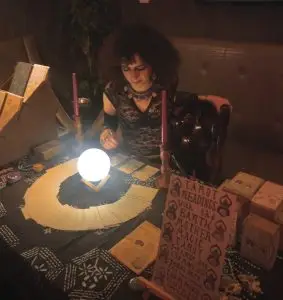
Over the years, I have been making some of my income as an artist by facilitating readings with my tarot deck both in-person, online and at events in London. However, the readings that are most in alignment with the energy and values of my tarot deck are the ones that take place in intimate settings with people close to me, and in community environments with other queer people and women. Though tarot is often conceptualised and portrayed as a practice with a reader-recipient dichotomy, where the tarot reader is positioned as having spiritual authority over the recipient of the reading, I find readings that take a conversational form more authentic.
In recent months I have been more intentionally developing a collective tarot practice, where I have been informally facilitating readings where multiple participants pull cards with a shared question, and interpret the cards together. I feel this allows for all participants to take spiritual agency and goes against the grain of the gatekeeping of tarot. For me, tarot is about interpreting images, identifying patterns through the symbology within the cards, and open-ended, collaborative meaning-making. It relies on intuition more than anything else – which can be accessed without necessarily having formal knowledge of the cards.
I do think tarot has the potential to be used as a consciousness-raising tool within movements, to collectively engage more deeply with the personal-as-political, and as a tool for discussions that can be both emotional, intellectual and practical. I most recently facilitated a collective tarot night at House of Annetta on the New Moon in Cancer, for artists, organisers and researchers who are part of the community of the space. I hope to transform this into a regular practice and continue to co-create new anti-hierarchical, queer and feminist approaches to tarot-card interpretation.
You can see Ayshe-Mira’s decks here.
Hand-pressing every deck is the thing that stayed with me. There’s a limit built into it that mass printing removes, and the limit is doing real work: you can’t make a deck for someone you’ve never thought about. The Ana Mendieta influence comes through in the interview more than in any description of the art.
I absolutely love Ayshe-Mira’s dedication to the DIY process and her commitment to ethical sourcing for her Earth Mother Magic Tarot. It’s so refreshing to hear about an artist pouring so much personal energy and intention into each deck, even including handmade herbal sachets! That really makes the deck feel incredibly special and connected to her values.