
Rudy: I am an artist and I have a practice of gathering people together through spiritual practice and community organising. A lot of my work is focused on storytelling, sociopolitical themes and radical histories.
I have had a tarot practice for the last twelve years and my connection to spirit is deeply embedded in my work as an artist.

Kaan: We’re honoured to have your book in the shop. Both me and Elena really felt it’s power when we read it. From the first page, I was grateful for your honesty, reflectiveness, not trying to sugarcoat things. And then of course there are the references to tarot throughout the book, the persistence of the tower card coming up for you. Could you tell us a bit about the book in your own words, and your relationship with tarot, and how the two things relate to each other?
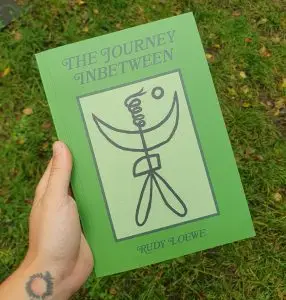
Rudy: The book documents a journey that I was going on over about a year or two and this was an experience that was, in part about disability, but it was also a very spiritual experience. And so it felt important to share how tarot and spiritual practice is an anchor and a guide in my life. Particularly through this crisis, tarot and my ancestor practice was a guiding light when things felt very difficult.
Kaan: Alongside the book, you are also currently exhibiting at the Wellcome Collection in London, UK, until 07 February 2027. The exhibition title is so beautiful; “Intimacies of Care – Spaces of Grief and Possibility”. The exhibition shows the consistent failings of the UK mental health system, particularly toward Black people. And also shows so tenderly the possibility of better care, in the thoughtfulness of everything in the exhibition, from the sofas when you arrive, to the multiple ways of engaging and interacting, in the soft colour palette. How would you describe the exhibition and its asks?
Rudy: Intimacies of Care – Spaces of Grief and Possibility is a vessel to hold all that might come up for people in terms of thinking and feeling around Black mental healthcare in the UK. At the heart of it is how I have been held by disabled queer and trans community, and the ways that we have supported each other, creating systems of our own in response to the lack of care that we have often received. This then became the basis for offering a space for people to collectively reimagine what care can feel like.
The exhibition is connected both to the historical, referenced through archival material, and the present experience of healthcare. One artwork in particular is rooted in the current moment, calling for significant change to the UK mental healthcare model which relies on incarcerating people. There is a petition that people can sign, urging for community-centred care that would give us the resources to have more autonomy over our own care.
Kaan: One of the things I love about the book and the exhibition is the reference to your loved ones and Spirit and elders, and folks who have held you through. I’m wondering if you’d be up for saying a bit more about care that sits within our communities and exists outside of these systems we outsource to, like hospitals and mental health institutions?
Rudy: Yes, so neoliberalism encourages us to imagine that care is something that we do for ourselves or that it happens in isolation or that we receive it through a service. Particularly heterosexual culture in the UK promotes the idea that the only people you should rely on are your partner or your family (M. Jacqui Alexander writes about this idea in Pedagogies of Crossing and I think it’s mentioned in The Care Manifesto by The Care Collective too).
The care that I reference is a collective care rooted in disability justice and diasporic cultures who acknowledge that it is impossible to experience care by ourselves. Care is something that is done in connection, whether that is with your neighbours, your friends, family or wider community. It’s about understanding that there is a network of care that we rely on to survive.
Kaan: What are the decks and /or cards that you always come back to?
Rudy: The Tower! The Journey Inbetween actually taught me to love The Tower. It’s such a clear signal for me now for when things need to be let go of, that I am no longer afraid of it and it feels welcome now.
Some of the decks that I love are my OG deck — my ride or die — the Thoth deck. I also collect a lot of different decks. I love the artwork of the Next World deck and the Dirt Gems oracle deck.
Kaan: Please also do write about anything else you’d like to share
Rudy: The title of the book, The Journey Inbetween, refers to a place. The Inbetween is not so much about moving through different places as it as about it being a place of it’s own. To be in the Inbetween is to exist in a no man’s land, a limbo. It is a place of shadow, darkness and unknown.
You can sign Rudy’s petition for community-centred care here.
You can buy Rudy’s book here.
You can see more of Rudy’s work here:
www.rudyloewe.com
@RudyLoewe (insta)